
The Work You Haven't Automated Yet: AI in UK Wealth Management
Most AI in UK advice firms drafts meeting notes and follow-up emails. The expensive work sits underneath. This post is for the paraplanners, advisers, and principals who suspect they're using AI for the easy half.
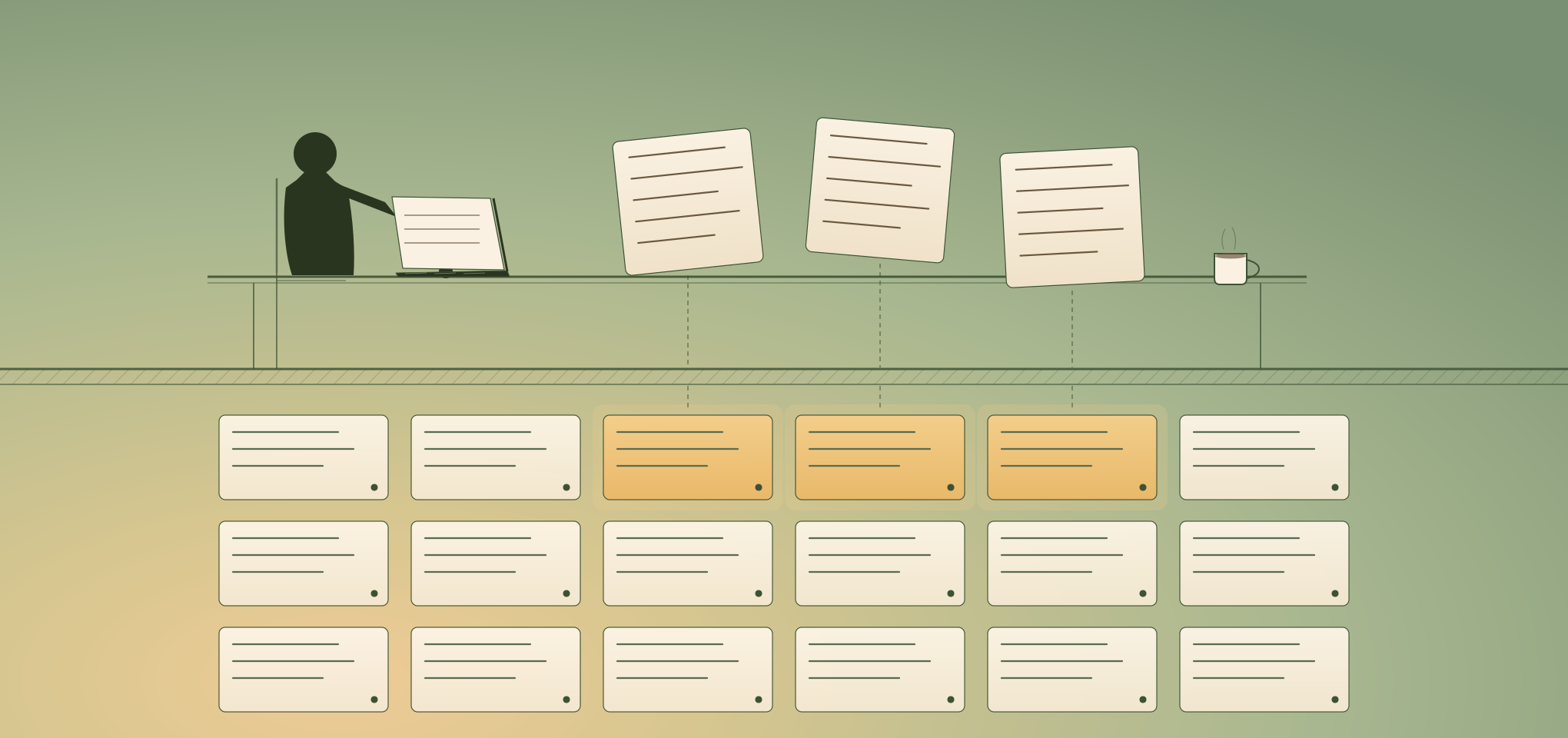
Thesis (for quick reference) Half of UK advice firms are using AI. They are using it for the easy half. The expensive work, where conversations become structured client records and structured records become defensible advice, is what almost no current tool does. Three tests sort the AI vendors built for regulated workflows from the ones built for drafting. Three capabilities emerge once a tool passes them.
Key takeaways
- Half of UK firms use AI for the visible work. Almost none do the harder layer underneath.
- Three tests decide whether an AI tool belongs in a regulated workflow. Cite. Confirm. Cross-check.
- Once AI passes those three tests, three capabilities emerge. Capture, Qualify, Document.
- For principals, the qualifying layer matters more than the drafting layer.
Most of the AI being sold to UK advice firms today does the visible work. Meeting notes. Draft emails. Summaries that look impressive in a demo. The expensive work is invisible. This post is about the invisible work.
For the last four months, every conversation I've had with a UK adviser has ended in the same place. A director and financial planner in Dundee with thirteen years on Intelligent Office. A portfolio manager at a London private bank. An associate planner at a national UK wealth manager. A senior paraplanner with Level 7 qualifications and a former MD of the London Institute of Banking & Finance. Different firms, different sizes, the same conclusion.
In April, we ran a benchmark across 18 UK advice firms: paraplanners, advisers, compliance officers, an auditor. The numbers said exactly what the conversations had been saying. Half the firms are using AI. They use it for almost the same three things: meeting notes, summarising documents, extracting facts. Two firms out of eighteen said they use AI to search across multiple documents. Nobody is using AI for prospect qualification. Nobody is using AI for suitability scoring. One respondent, asked for their top blockers to AI adoption, wrote down a single line: "Not knowing what else we could be using."
This post is for the people who wrote that line, and for the people who would have, if there had been space on the form.
What the visible work looks like
If you have AI in your firm right now, this is most likely what it does. Your meeting platform, whether Teams, Zoom, or sometimes Otter, produces a transcript. A tool drafts notes from the transcript. Another tool, or the same one, drafts a follow-up email. If you've gone further, a tool drafts a section of a suitability letter from the transcript, which a paraplanner then edits.
These are useful. Nine of eighteen firms are doing some version of it. I'm not here to argue against any of them. If you're not doing this yet, you should be. Meeting transcription alone saves a paraplanner real time, and the productivity gains are visible inside a week.
But it's the visible work. It happens after the conversation, on top of what was said, drafting what comes next. It does not touch the layer underneath. The documents that already exist for the client, the historic fact-finds, the provider statements, the previous suitability work, the platform exports, the years of accumulated material sitting in OneDrive and SharePoint and intelliflo and a network drive nobody renamed in 2019. That layer is where the friction lives. That layer is the invisible work.
Where the time goes
A senior paraplanner I spoke with described his typical opening to a new file. "I could spend maybe half an hour, forty-five minutes before even putting pen to paper. Simply getting up to date. Then maybe having a conversation with my principal saying: do I have this right?"
The associate planner at the national wealth manager described the same problem from the adviser's side. She knows everything about the client because she was in the meeting. The paraplanner sitting behind her does not. So between the meeting and the suitability draft, two hours of work happen which don't appear on anyone's diary. The paraplanner reads the transcript, opens the previous fact-find, checks the platform statement, cross-checks what the client said against what the documents show, and writes it down before the suitability draft even starts.
The portfolio manager at the private bank put it differently. She said the decision is the easy part. If a prospect clearly fits the firm's criteria, she onboards them. She doesn't need AI to make that call. What she said would be "hugely beneficial" is everything after the decision. The structured client picture, the CRM fields, the suitability letter in her firm's voice. Right now, that piece is manual and it sits between her meeting and her next meeting.
The pattern repeats. The bottleneck is not the conversation. It is not the drafting. It is the layer in between, where the conversation becomes a structured client and the structured client becomes a defensible piece of advice.
That layer is what no current tool is doing for UK advice firms.
Why the layer hasn't been built
A fair question to ask. There are vendors in the UK advice space. AdvisoryAI, Aveni, Jump AI, Otto. Several claim compliance features. So why am I writing as if nothing in this space has been built?
Because there are two different things people call "compliance" in AI for advice, and only one of them is being widely built.
The first is output-side checking. After the AI drafts a suitability letter, a rule-engine reviews it against a handbook. Does it mention vulnerability? Does it cite Consumer Duty principles? Does it match the firm's house style? This is real work and useful work. AdvisoryAI does it. Aveni does it. A sensible thing to add on top of drafting.
The second is input-side grounding. Before the AI drafts anything, every field, every number, every claim, every objective, has to be traceable to a source document. The £650,000 the client said in the meeting has to be checked against the £630,000 on the platform statement. The retirement objective has to link to the exact sentence in the transcript. The capacity-for-loss assessment has to be defensible three years from now against the meeting, the documents, and the historic file, together.
Almost nobody is building input-side grounding for UK advice. It is harder. It needs the historic document layer to be structured before any drafting happens. It needs paragraph-level citation as a built-in property of every output, not an audit feature bolted on later. It needs cross-checking between what was said and what is documented. None of this gets you a flashy demo. All of it is what makes AI defensible in a Consumer Duty supervision visit two years after the file was closed.
That's the layer the tools didn't reach until recently. The reason it's reachable now is mostly technical. The model quality for structured extraction from messy, multimodal financial documents (scans, statements, fact-finds, handwritten notes) has crossed a threshold in the last 18 months, and the architecture for paragraph-level citation has stabilised. The conclusion is the same. The work is no longer impossible, and the firms which move first will have something most of their peers don't.
The three tests
When I talk to advisers about AI now, I've started using three tests. Any AI tool you deploy inside a regulated advice workflow has to pass all three. They are not difficult to ask, and they sort vendors quickly.

Test one: Cite
Every fact the tool produces, every income figure, every objective, every risk score, has to link to the exact paragraph, in the exact document, where it came from. Not "based on the meeting". The sentence. If a vendor cannot show you per-field citation in their demo, the tool hasn't been built for regulated advice. It has been built for drafting.
Test two: Confirm
The paraplanner or adviser has to be the one who decides whether each output gets into the client record. The AI suggests. The human confirms. Anything which writes directly into the file without a confirm step is the firm taking liability for whatever the model produces, including when the model is wrong. Look for a per-field confirm step, not a "review the whole document" workflow. The difference matters under the FCA's accountability rules.
Test three: Cross-check
When the client says one thing in a meeting and the documents say another, the tool has to surface the discrepancy, not silently pick one. The senior paraplanner I quoted earlier had tried ChatGPT for PDF extraction. He stopped using it after it hallucinated a regulatory reference which didn't exist. The associate planner I quoted earlier said something similar about Copilot. It answers word questions fine, but it falls apart on numerical, multimodal, or calculation-based queries. Cross-checking is the test which distinguishes an AI you trust from an AI you have to verify behind every output anyway. Without it, you've replaced re-keying with re-checking, and re-checking is slower.
If a tool passes these three tests, you deploy it inside a regulated workflow and defend it. If it fails one, you can't, regardless of what the marketing says.
What becomes possible when AI passes the three tests
This is the part the survey respondent was asking for. "Not knowing what else we could be using." So, here is what else.
Once AI is grounded properly, three things happen which the visible-work tools cannot do.
Capture
A first client meeting produces a transcript. The transcript already contains nearly everything you need. Assets, objectives, time horizon, capacity for loss, existing arrangements, family situation, vulnerability indicators. The AI extracts the relevant fields and pre-populates the fact-find. Every field links to the sentence in the transcript it came from. The paraplanner clicks through (confirm, confirm, edit this one, confirm, confirm) and the fact-find is done in forty minutes instead of three hours. The transcript was always there. Most firms had no way to use it as data.
This is what nine out of eighteen survey firms are already partially doing, but only partially. Most use AI to draft notes from the transcript. They do not use AI to populate the fact-find from the transcript with field-level citation. That is the part which changes the week.
Qualify
This is the one almost no UK advice firm is doing yet. Most firms have an implicit picture of an ideal client: minimum assets, complexity tolerance, services available, behavioural fit, geography. The portfolio manager I quoted earlier knows hers in thirty seconds. Most firms write theirs down in a proposition document and never look at it again.
When AI structures the client picture from a first meeting, and you have written down what your firm's ideal client looks like, the two are compared. Before a paraplanner touches the file, the AI scores the prospect against the firm's profile (commercial value, complexity, behavioural fit, suitability) and surfaces the discrepancies. This prospect's stated assets are below the firm minimum. This prospect's time horizon is shorter than the recommended discretionary mandate. This prospect's stated objective is not a service we offer.
The score is not a decision. The adviser still makes the call. But the call gets made on Tuesday morning, not in week three. That is the difference between writing off four weeks of paraplanning on a non-fit and writing off thirty seconds of reading a score. Multiply by how many prospects don't become clients in your firm. The number is larger than most principals think.
Document
Suitability letters in most firms are written in a house style which took years to develop. Each adviser has slight variations. The senior paraplanner I quoted earlier described the structured-fields part of suitability as easy. The hard part is the narrative. "You work as Operations Director at ABC Ltd, earning £60,000 base with car benefit and a 10% discretionary bonus." The prose which turns numbers into a defensible client story.
When the AI extracts the structured fields and drafts the narrative in your firm's voice, with every sentence linked to a source, two things happen. The paraplanner stops re-writing the same prose every week. And the audit trail, the thing your principal cares about, exists by default. Not assembled the night before a supervision visit. Built as you work.
The Capture, Qualify, Document loop is what happens when AI passes the three tests. The visible-work tools cannot do this, because they sit downstream of the layer where structure is built.
Why the principal reading this should care more than the paraplanner
If you've read this far as a paraplanner or adviser, you already understand the operational value. Forty minutes versus three hours on a fact-find. Catching a misfit prospect in week one instead of week four. Not rebuilding the same suitability narrative every Tuesday.
If you run the firm, the implication is different and worth saying directly.
The first thing is capacity. Your paraplanning bottleneck is real. You solve it by hiring. Average paraplanner cost in 2026 is around £42k loaded, takes six months to ramp, and competes with every other firm trying to hire. Or you solve part of it by getting your existing paraplanners' first three hours per file back. That is not a marginal saving. That is another client per paraplanner per month, at the same headcount, with better evidence trail.
The second thing is the risk register. Six of eighteen firms in our benchmark have no AI policy at all. A third of respondents are using AI in client work without a documented governance framework. The accuracy and hallucination blocker (55% of respondents listed it in their top three) is what your compliance officer worries about, correctly. Deploying AI which passes the three tests does more than free up paraplanner hours. It moves AI risk off the firm's risk register, because every output is defensible by default. That is a different conversation with your PI insurer.
The third thing is acquisition. If you run a firm with growth ambitions, and most of you do, the qualifying layer matters more than the drafting layer. Drafting saves your team time per client. Qualifying changes which clients you take. In a market where the great wealth transfer is moving £5.5 trillion between generations and inheritor loyalty to existing wealth managers is low, the firms which qualify and onboard well will keep clients. The firms which take three weeks to realise a prospect didn't fit will lose them, and the referral too.
The MDs who've been quietly piloting AI tools at the drafting layer are early. The MDs who pilot at the qualifying layer in 2026 will be ahead.
Why I'm writing this down
After four months of these conversations, I've started writing down what I'd want every UK advice principal to know about AI before they sign anything. Not because I think you're getting bad advice. Because I think the AI conversation in your sector has rewarded activity over impact, and the most expensive work (qualifying, structuring, grounding) is treated as a downstream extension of the drafting layer when it is the foundation underneath.
I'm Rohan. I'm building Chunkbase from Glasgow. We've been building the input-side grounding layer this post is about. Fact-find extraction from meeting transcripts with paragraph-level citation. Suitability scoring against firm profiles. Cross-checking transcript claims against client documents. Suitability letter drafting in the firm's voice with every sentence cited. We do not do the visible work the existing tools do well. We do the layer underneath which lets the visible work be defensible.
That's the bias. You should read this post knowing it.
The three tests are yours to use regardless. Cite. Confirm. Cross-check. If you only take one thing away from this, take those three. They will save you signing the wrong AI tool. They will save your compliance officer a conversation. And they will, eventually, change which firms in your sector get to call themselves AI-ready.
Get involved
Chunkbase builds the input-side grounding layer this post argues for. We work with UK advice firms on fact-find extraction, suitability scoring, and cited drafting.
Run the three tests on your current AI vendorAsk them for per-field citation, a per-field confirm step, and surfacing of transcript-document discrepancies. If they do not show you all three, you have your answer.
Contribute to the benchmarkThe numbers in this post come from the UK Advice Firm Document Operations Benchmark. It takes five minutes. Participants get the full results back.
Talk to usIf your team still re-keys after every meeting, or you want a walkthrough of how to evaluate vendors against the three tests, contact us.
This piece draws on four months of discovery conversations with UK paraplanners, advisers, and compliance professionals between January 2026 and April 2026, and on the UK Advice Firm Document Operations Benchmark 2026 (18 respondents, April 2026). Specific quotes are attributed by role, not name, in line with our discovery-confidentiality practice.
Next in this series: "Cite, Confirm, Cross-check: the three tests for AI in regulated advice, with worked examples."